

Event Planning Business Plan Template
Event Planning Business Plan Template
A working plan for a one-person or small-studio planning practice: fee structures with the arithmetic shown, season-by-season cash flow, and the permits that decide whether a venue will let you on site.

Download Your Free Event Planning Business Plan Template
DIY template with step-by-step instructions. Editable Word doc — yours in 30 seconds.
Your First 12 Months, Keyed to Event Season
Most launch guides for this trade hand you a generic checklist. That checklist will quietly cost you a year, because event planning has two hard calendars sitting on top of each other and neither of them cares when you incorporated. Weddings cluster from May to October in the northern hemisphere. Corporate work clusters twice: sales kick-offs and conference season from late January through April, then holiday parties and year-end client events from October to mid-December. A planner who registers the company in March and starts marketing in June has missed the wedding enquiry window for that year entirely, because couples book planners nine to sixteen months out.
The sequence below assumes a standing start in January with no bookings. Shift it if you are starting elsewhere in the year, but keep the relative order: contracts and insurance before first paid work, portfolio before paid advertising, and a signed second client before you commit to software tiers you cannot cancel.
Months 1–2: legal shell, contracts, and the insurance certificate
Form the entity, get the EIN or UTR, open a properly separate business bank account, and bind general liability cover before you set foot in a venue. Insurance comes this early for access rather than caution: hotels, municipal parks and most university venues will not issue a vendor pass without a certificate naming them as an additional insured, and that endorsement takes a day to issue but a week to discover you cannot get from a cheap policy. Draft your client agreement in this window too, with three clauses most new planners omit: a payment schedule tied to vendor deposit dates rather than calendar months, a cancellation ladder that retains a rising share of the fee as the event approaches, and an explicit statement of whether you accept vendor commissions.
Months 2–3: build a portfolio you did not need a client for
Nobody hires a planner without photographs, and you cannot photograph an event you were not hired for. Two routes solve it without pretending. First, assist: offer a working day rate to two established planners for their peak-season weekends and you will learn their vendor list, their timeline formats and their crisis habits while standing on site with a camera. Second, produce a styled shoot: book a venue off-peak, trade credit with a florist, a stationer, a rental house and a photographer, and build one fully designed tablescape and ceremony set. A styled shoot is understood in this trade as a design portfolio piece rather than a real wedding, so presenting it honestly costs you nothing. Budget $500 to $2,000 for photography; it is the highest-return line in the startup budget.
Months 3–4: pricing, proposal template, and the first five conversations
Set your fee structure before you take the first enquiry, not during it. Improvise a number on a discovery call and you will anchor low, then spend two years climbing out. Write a one-page proposal with three tiers (month-of coordination, partial planning, full design and planning) and real prices attached. Then have five conversations: your former employer, two venue coordinators, a caterer and a photographer. Venue coordinators are the highest-yield referral source in this business by a wide margin, because they are asked "can you recommend a planner?" several times a week and they recommend whoever last made their life easy.
Months 4–7: first paid events, deliberately underpriced
Your first two or three jobs should be priced to win, scoped tightly, and documented obsessively. Take month-of coordination work rather than full planning for these: shorter engagement, fewer ways to lose money, and the same photographs at the end. Log every hour. Not approximately: actually, in fifteen-minute blocks, in whatever tool you already use. You are buying the data that will let you price correctly for the rest of your career, and nobody can give it to you because it is specific to how fast you work.
Months 6–9: software, systems and the second revenue line
Only now commit to paid platforms, because by this point you know whether your bottleneck is contracts and invoicing, design and floor plans, or multi-event coordination. The 2026 price points are public: HoneyBook runs $29 a month on Starter with an annual plan, $49 on Essentials and $109 on Premium; Aisle Planner starts at $49.99 for CRM only with zero active projects and $69.99 for fifteen projects, scaling to $229.99 for high-volume studios; Planning Pod's Planner tier sits around $49 to $74 a month, up to roughly $159 for the largest plan; and Social Tables, which does to-scale diagrams, has a usable free tier of one user and three events, with paid plans from about $49 to $320 a month on twelve-month commitments Event Planning Blog, 2026 and That's The One, 2026. Pick one. Planners who subscribe to three overlapping platforms in year one are, in our experience reviewing these plans, the same planners whose overhead line later makes the business look unprofitable.
Months 9–12: book across the trough, then raise prices
The twelve-week window from early January to late March is where undercapitalised planning businesses die. Wedding deposits have stopped arriving, the previous season's final payments have been spent, and corporate enquiries for spring have not converted yet. Two fixes belong in your plan now rather than next year: a December-to-February product that sells into the trough (corporate kick-off meetings, charity gala committees, proposal and engagement-party work, January wedding-show stand presence), and a deposit structure that holds back 35% of the fee until the event rather than collecting everything on signature, so the cash arrives when the work does. Then raise your rates for the following season by 20% to 30%. You will have photographs, reviews and logged hours; the first repricing is always the easiest.
Related reading on sequencing a launch with a seasonal order book: our event catering business plan template covers the same calendar from the food-production side, and the event rental business plan template models it from an asset-utilisation angle.
What It Costs to Open, Line by Line
Event planning is one of the cheapest licensed-adjacent service businesses to start and one of the easiest to under-capitalise. Published ranges put a realistic launch at $2,000 to $20,000, with no specialist licence required in most jurisdictions and net margins settling between 15% and 40% StartCosts, 2026. The spread is almost entirely marketing, photography and software choices; the compulsory items come to under $1,500 in most US states and under £800 in the UK.
The compulsory floor
- Entity formation: $50–$500 for a US LLC depending on state; £50 to incorporate a UK limited company online, or nothing to register as a sole trader with HMRC.
- EIN or UTR: free. Anyone charging for this is selling a form you can file yourself in ten minutes.
- General business licence: $50–$150 a year in most US cities and counties. The UK has no equivalent general trading licence.
- General liability insurance at $1M / £1M: $400–$800 a year for a solo planner, and the additional-insured endorsement matters more than the premium.
- Business bank account: free to $20 a month. You will be holding client money earmarked for vendor deposits, and commingling it is how planners end up personally liable.
The lines that actually decide whether you get booked
Everything above gets you legal. The next tier gets you hired, and this is where plans we review go wrong in both directions: some founders budget $300 total for marketing and then wonder why the phone is silent, others spend $8,000 on a brand identity before booking a single event.
- Website with a real portfolio: $200–$2,000. A single-page site with twelve strong photographs, three priced tiers and a working enquiry form outperforms a $5,000 custom build with a hidden price list.
- Portfolio photography: $500–$2,000.
- Planning software and CRM: $29–$300 a month combined. One platform in year one.
- Certification (optional): $0–$2,000 for CMP, CSEP or a QC Event School course. No US state or UK authority requires a planning qualification, and experience consistently outranks credentials here; certification helps most with corporate procurement panels.
- Marketing and directory presence: $300–$3,000. Regional wedding-show stands run $700–$2,500; directory listings and review-platform claims are mostly free and mostly neglected.
- Sample kit: $200–$1,500 for linens, chargers, candlesticks, signage mock-ups and a client-meeting presentation box.
The working-capital line nobody budgets
Here is the number that separates plans that get funded from plans that get questions. In this business you routinely pay vendor deposits (florist, rental house, lighting, tenting) against an event that is eleven months out, and your client's payment schedule does not always line up with the vendor's. A single 200-guest wedding can require $6,000 to $14,000 of vendor deposits placed before the second client instalment clears. If you are passing those through your own account, you need a reserve. Budget $500 to $6,000 of working capital explicitly, and write into your contract that vendor deposits are either paid directly by the client or invoiced to the client fourteen days before you place them. Plans that model this are the ones lenders read twice.
Funding routes, with the real numbers
US planners generally fund this business from savings, because $5,000 is below the threshold where bank lending is worth the paperwork. Where SBA lending does appear in this sector it is at a very different scale: across NAICS 561920, convention and trade show organisers, there were 464 SBA loans totalling $204.1M, with a 2024 average loan size of $440,000, an average ten-year term and an average rate of 10.55% Fair Market Value, NAICS 561920. Those are venue-holding and production companies, not solo planners. If you are applying as a planning practice, the realistic SBA products are the Microloan programme (up to $50,000, typically through a community development lender) and an SBA Express line of credit for working capital against receivables, and both will want the seasonality modelled, not asserted.
In the UK the obvious route is the government-backed Start Up Loans scheme: £500 to £25,000 per founder at 6% fixed over one to five years, with free mentoring attached, and an average loan around £10,264 Start Up Loans, British Business Bank. Two founders can each apply, which is how a two-person studio raises £30,000–£40,000 without equity. The underwriting is personal-credit led and the business plan requirement is genuine: a cash flow forecast showing the January-to-March trough and how it is covered is the part assessors actually read.
If you need the forecast built rather than described, our market research and content package produces the model and the narrative together, and the business plan writer service page explains how the engagement runs.
Where the Fees Are: Metro and Regional Benchmarks
Planning fees track two local variables: what the metro pays salaried planners, and what households and companies in that metro spend per event. Both are measurable, which makes this one of the few parts of an event planning business plan you can ground in published data rather than optimism.
On the wage side, the US Bureau of Labor Statistics tracks meeting, convention and event planners as SOC 13-1121. National median annual pay was $59,440 in May 2024, with the bottom decile under $35,990 and the top decile above $101,310, across 155,800 jobs; employment is projected to grow 5% from 2024 to 2034, adding 7,500 posts, with roughly 15,500 openings a year once churn is counted BLS Occupational Outlook Handbook, 2024. State medians diverge sharply: the District of Columbia leads at about $76,970, followed by Massachusetts near $75,740, New York around $74,730 and Hawaii around $74,460, while California, New York and Texas carry the largest absolute headcounts BLS OES state tables, 2025.
Why a salary table matters to someone who will never take a salary: the employed median is the floor your pricing has to clear. If a Boston company can hire a planner in-house for $75,000 plus benefits, roughly $92,000 fully loaded, your corporate day rate has to make outsourcing obviously cheaper than that at the volume they actually have. In Nashville or Kansas City the same arithmetic runs at $55,000 to $60,000, which is why mid-market metros reward specialisation over generalist corporate work.
On the spend side, the reference point is The Knot's study of 10,474 US couples married in 2025: an average wedding cost of $34,200, $292 per guest against a 117-guest average, and thirteen vendors engaged per wedding The Knot Real Weddings Study, 2025. A full-service planner averaged $4,100 on that dataset. Note the ratio: the planner is around 12% of total spend, which is the empirical check on anyone quoting 20% in a market where the average wedding is $34,000 rather than $90,000.
How the metro tiers break down in practice
| Market tier | Examples | What drives demand | Indicative full-service wedding fee |
|---|---|---|---|
| Tier 1 corporate & luxury | New York, Washington DC, Boston, San Francisco, London | Association conferences, financial and legal client events, high-budget private celebrations | $8,000–$25,000+ |
| Tier 2 regional hubs | Chicago, Atlanta, Dallas, Denver, Manchester, Edinburgh | Mid-market corporate, large private weddings, trade association events | $4,500–$12,000 |
| Tier 3 destination markets | Charleston, Scottsdale, Napa, Savannah, the Cotswolds, Lake Como | Inbound destination weddings; clients who need local vendor knowledge they cannot get remotely | $6,000–$20,000 plus travel |
| Tier 4 secondary and rural | Smaller metros and county markets in both the US and UK | Volume over value: coordination packages, milestone parties, community and charity events | $1,500–$4,500 |
Fee bands are Avvale estimates built from BLS state wage medians and The Knot per-market spend data, not survey figures. Use them as a sanity check on your own quoted prices, then validate against three live competitor quotes in your actual postcode.
The UK market is more fragmented. IBISWorld counts 5,555 party and event planner businesses against revenue of around £2.38 billion through 2025-26 IBISWorld UK, 2025, an average of roughly £428,000 per business with a median far below it, because the sector is mostly sole traders and two-person studios with a few corporate agencies at the top. For a new UK planner that fragmentation is an advantage: no dominant brand in most regions, and venue-led referral still decides who gets the enquiry.
Permits, Insurance and the Paperwork Clients Never See
There is no such thing as an "event planner licence" in the United States, the United Kingdom or Canada. What exists instead are two separate layers, and conflating them is the most common error in draft plans we review. The business layer licenses you as a company. The event layer licenses each individual event, usually in the client's or venue's name, and you are the one who has to know the deadlines.
United States
Business-layer requirements come down to an entity filing, an EIN, a general business licence from the city or county, and a seller's permit where your state taxes what you sell Wolters Kluwer. Filing fees run $50 to $500 for the LLC, $50 to $150 a year for the business licence, and free to $50 for the seller's permit StartPermit, 2026.
The seller's permit is the trap. Most planners assume it does not apply because they sell a service. It applies the moment you buy goods at wholesale and rebill them to the client: favours, linens, chargers, candles, signage, rented decor you mark up. California's tax authority publishes guidance specifically for this trade: if you purchase tangible items and transfer them to your client, you are making a retail sale and the transaction is taxable, with the permit and the returns that follow California CDTFA, Event Planners. Planners who rebilled decor for three years without a permit do not get a warning letter, they get an assessment with interest.
The event layer is per venue and per city: a special event permit, fire marshal sign-off on the floor plan and occupancy, a temporary food establishment permit where food is prepared on site, and a liquor or caterer's permit where alcohol is served. Insurance floors are published and specific. San Francisco sets out certificate requirements for every special event permit it issues City of San Francisco, Seattle publishes its own schedule City of Seattle, and California State Parks requires every applicant to carry no less than $500,000 naming the State as an additional insured, rising to a $1,000,000 combined single limit where it judges the event higher-hazard California State Parks. Large municipalities commonly want applications 30 to 90 days ahead, which is why "the client will handle permits" is a sentence that ends in a cancelled event.
United Kingdom
Registration is the easy part: sole trader with HMRC for nothing, or a limited company at Companies House for £50. The licensable activity rules under the Licensing Act 2003 are where planners get caught. A Temporary Event Notice covers alcohol sales or regulated entertainment at a one-off event, but only if the event stays under 500 people at all times including staff and runs no more than 168 hours. A standard TEN must reach the licensing authority and the police no later than ten working days before the event. An individual can be given up to five TENs a year, rising to fifty if they hold a personal alcohol licence GOV.UK. Cross 500 attendees and you are into premises licence territory, with a 28-day consultation and realistically two to three months of lead time.
The change UK planners need in their plans now is Martyn's Law. The Terrorism (Protection of Premises) Act 2025 received Royal Assent on 3 April 2025. Its substantive duties are not yet in force, because the Act carries an implementation period of at least 24 months, so enforcement is expected around 2027. The tiering is already known: a standard tier for premises and events with a capacity of 200 to 799, and an enhanced tier at 800 and above, with documented procedures for evacuation, invacuation, lockdown and communication Freeths, 2025. Treat it as commercial advantage rather than burden: planners who can walk a venue through a compliant procedure are the ones venues will recommend from 2027.
Ontario, Canada
Alcohol at a one-off Ontario event runs through an Alcohol and Gaming Commission of Ontario Special Occasion Permit. The lead times are asymmetric and worth memorising: a private indoor event with invited guests only needs the application in ten days ahead, while all other indoor events (public, bring-your-own, industry promotional) need thirty days AGCO. SOPs are for occasional events only and cannot be used to run a continuing business, so a planner hosting a recurring ticketed night needs a different licence class. Municipal layers sit on top: Mississauga issues its own special event licence, Toronto handles road closures and noise exemptions separately, and every food or merchandise vendor needs its own business licence, which in practice is the planner's job to verify before the vendor arrives. Our template includes a jurisdiction checklist you fill in once per market, so this section of your plan reads as specific rather than hedged.
Four Ways Planners Get Paid, and the Maths Behind Each
Fee structure is the highest-variance decision in this business and the one most new planners make by accident. Four structures are in live use, and each has a specific failure mode. Survey data puts the distribution roughly as follows: flat project fee is the most common method overall, percentage of budget dominates full-service corporate work, and hourly billing splits with 35% of planners charging $50–$99, 31% at $100–$149, 23% at $150–$199 and 3% above $200 DesignRush, 2026, Event Planning Blog, 2026.
1. Percentage of event budget: 10% to 20%
Independent planners typically charge 10% to 20% of total event spend, with 15% to 20% standard for full-service corporate events where the planner is sourcing vendors and running the room. A $50,000 event at 15% to 20% carries a planner fee of $7,500 to $10,000. The structure is clean to explain and scales with complexity, which is genuinely fair on large productions.
Its failure mode is precise and worth stating plainly: your fee falls exactly when the work rises. When a client trims the budget from $60,000 to $42,000, the hours do not fall. They rise, because you now have to re-source three vendors and redesign to a lower spec, and your fee drops by $2,700. Percentage pricing also makes you look like you have an incentive to inflate the budget, which is the single most common objection corporate procurement raises. Use it where you control the budget. Avoid it where the client does.
2. Flat project fee: $2,000 to $50,000+
A flat fee against a written scope is the most common structure and the easiest to defend. It makes you look like a professional service rather than a percentage broker, it removes the inflation objection, and it lets you price your expertise rather than your client's wallet. Tiering it is standard: month-of coordination, partial planning, full design and planning. The failure mode is scope creep: without a change-order clause, the fourth round of seating revisions is free. Write the clause: two rounds of design revision included, further rounds at your hourly rate, in the contract, at signature.
3. Hourly: $50 to $200+
Hourly suits consulting-style engagements: a company with an internal team that wants a professional to audit the run-of-show, or a couple who need twelve hours of vendor-shortlisting help. It is a poor primary structure for full events, because clients cannot forecast the total and start economising on your time at precisely the wrong moments. Keep hourly as your change-order rate and your consultation product, not your main offer.
4. Vendor commission: 10% to 15%
Many vendors pay a referral commission of 10% to 15%. It is legal nearly everywhere and a real revenue line, but it is a trust liability: a client who discovers an undisclosed markup on the florist will not refer you again, however ethical the arrangement was. The workable position is disclosure: state in the contract that you may receive vendor commissions and that recommendations are made on merit.
The worked example lenders actually want
Here is a single corporate conference, modelled the way a loan assessor reads it.
- Event: 180-delegate regional sales conference, one day plus evening dinner, $50,000 total client budget.
- Fee: 18% of budget = $9,000.
- Direct job costs: site visits and travel $280; floor-plan and seating software seat for the month $74; print and signage proofs $340; on-site assistant 14 hours at $32 = $448. Total $1,142.
- Gross profit: $7,858.
- Logged hours: 96 across eleven weeks (discovery and brief 6, venue sourcing and site visits 14, vendor sourcing and negotiation 22, design and floor plan 12, delegate logistics 16, run-of-show and briefing pack 9, on-site 13, wrap and reconciliation 4).
- Effective rate: $81.85 an hour before overheads.
- Overhead allocation: $1,480 a month of fixed cost (software $148, insurance $58, phone and internet $94, accounting $120, marketing $560, vehicle $200, subscriptions and misc $300) spread across three concurrent events over roughly 2.5 months of the engagement, about $1,233 to this job.
- Net contribution: approximately $6,625, or 13.3% of client budget retained.
Run that at twenty-four events a year with an average fee of $5,400 and you are at $129,600 of revenue and a net in the low-to-mid twenty-percent range after overhead and tax provision, consistent with the 15% to 40% net margin band reported for independent planners, and with the $50,000 to $150,000 annual revenue range typical of an established solo practice Starter Story, 2025. Agencies, by contrast, run 10% to 20% net because they carry salaried staff through the trough.
One thing most guides on this topic skip: the number that actually governs whether this business works is not your margin, it is concurrent capacity. A solo planner can hold three to four full-service events in active production at once before quality breaks. Four events a quarter at a $5,400 average is your ceiling without hiring, and that ceiling, not demand, is what your plan has to explain how you intend to lift. The three answers are: raise price per event, move up the budget tier, or build a bench of freelance on-site leads so you can sell more month-of coordination without being personally present at every load-in.
The Planning Services Market Going Into 2026
Almost every competing article on this keyword opens with the $1.3 trillion global events figure. That number is real but it is the wrong denominator: it covers venues, catering, audio-visual, staging, travel and ticketing. The market a planning practice actually competes in is the services slice, and it is about fifty times smaller.
The US trade show and event planning industry was worth $24.2 billion in 2025, having grown 1.4% over the year IBISWorld US, 2025. That near-flat figure is the honest headline for anyone writing a plan this year: the planning-services market is mature and growing with GDP, not booming. Share is taken from incumbents, not handed out by expansion.
The UK reads better. Party and event planner revenue is on track for around £2.38 billion through 2025-26 with a compound annual growth rate of 19.2% off a depressed base, spread across 5,555 businesses IBISWorld UK, 2025. Sitting above that, the total UK events economy was valued at £68.7 billion, an 11.4% year-on-year increase and its strongest showing since before the pandemic, supporting roughly 775,000 jobs and about 85 million event attendances annually Conference News, 2025.
Canada's planning industry is worth around C$2.9 billion in 2026 across 1,213 businesses, an average of roughly C$2.4 million per firm, which tells you how concentrated it is: a few large organisers and a long tail of owner-operators IBISWorld Canada, 2026. Globally the whole events economy stood at $1,338.77 billion in 2025 and is forecast to reach $2,086.73 billion by 2030 at a 9.3% compound rate The Business Research Company.
What the competitive top end tells you about positioning
The firms that define this market are not generalists. Colin Cowie built four decades of brand equity out of celebrity and Fortune 500 work across New York, Los Angeles and Las Vegas. David Stark's Brooklyn studio is hired by MoMA, the Whitney, Carnegie Hall, Target and Louis Vuitton on a single proposition: ordinary materials used at extraordinary scale. Rafanelli Events has staged more than 2,000 events across 50 cities from a Boston and New York base, including Obama White House functions and major nonprofit galas Social Tables, Event Planning Blog, 2026.
Every one of them is legible in a sentence, and that belongs in the positioning section of your plan. In a market of 5,555 UK businesses and tens of thousands of US ones, with no dominant regional brand and roughly flat growth, the defensible position is a narrow one: "corporate off-sites for 80 to 250 people in the Southeast", "Jewish weddings in the Chicago metro", "museum and gallery fundraising galas". Enquiry quality improves immediately, because the client who needed exactly that will not shop you against four generalists.
On demand composition, weddings remain the volume driver for new entrants: average spend held at $34,200 in 2025 with thirteen vendors engaged, and day-of coordination is the most-bought tier, ahead of full-service The Knot, 2025. Corporate work pays better per hour and bills on 30-day terms rather than deposits, but takes longer to win because it runs through procurement. Most durable practices end up with both: corporate for first-quarter cash-flow stability, social and weddings for summer margin.
For a deeper read on the agency-scale version of this market, see our event planning company business plan template; for the security and compliance layer on larger events, the event security business plan template covers it.
Need more than a template? We'll do the work for you.
Industry-specific structure. Write it yourself with expert guidance.
Download TemplateWe handle the research & narrative — investor-ready copy in 3–4 days
Get StartedFull plan + 5-year forecast, written by our team in 10–14 days
Book a CallFee Calculator: What Is Your Hour Actually Worth?
Enter the shape of one real event you have quoted or delivered. The calculator converts a percentage fee into an effective hourly rate, nets off direct job costs and your allocated overhead, and annualises it at your stated event volume. The point is not the fee; it is whether the hour behind it clears the employed median of $59,440 for this occupation.
Overhead is allocated on the assumption you run three events concurrently and each engagement spans about 2.5 months. Figures are indicative and exclude tax provision. Our paid packages model this properly, with monthly cash flow for year one.
Sample Business Plan Preview
An extract from a completed plan built on this template, so you can see the level of specificity we aim for. Company details are a composite.
Marquee & Thread Events LLC is a boutique event planning practice based in Charlotte, North Carolina, serving corporate clients across the Carolinas and social clients within a 90-minute radius. The company offers three tiers: Day-Of Coordination ($2,400), Partial Planning ($4,800) and Full Design & Planning ($7,900 plus a separately invoiced design retainer of $1,200 where custom fabrication is required).
Market position. The practice targets corporate off-sites and sales conferences of 80 to 250 delegates, a band under-served locally because the two largest regional agencies focus on 400-plus productions and local sole traders concentrate on weddings. Secondary revenue comes from nonprofit fundraising galas, where the board-committee buying process favours a planner who can attend evening committee meetings in person.
Operations. One full-time founder, a bench of four vetted freelance on-site leads at $320 per event day, and a preferred-vendor list of 31 suppliers across catering, florals, AV, rentals, stationery and transport. Maximum concurrent active productions: three full-service plus two coordination-only. Run-of-show documents, vendor briefing packs, floor plans, contracts and invoicing all run through a single platform to avoid version conflicts.
Year-one revenue plan. 23 events: 9 corporate (average fee $5,900), 11 social (average fee $3,250), 3 nonprofit gala engagements (average fee $4,400). Projected revenue $102,250. Direct job costs $18,400. Fixed overhead $17,760. Projected pre-tax profit $66,090 before founder's draw, with Q1 deliberately modelled at 9% of annual revenue and funded from the working-capital reserve.
Compliance. North Carolina LLC filed; Mecklenburg County privilege licence; North Carolina seller's permit held because decor and signage are rebilled; $1M general liability with blanket additional-insured endorsement, $2M aggregate; $500K liquor liability rider carried for events where the client holds the ABC permit...
The full version runs to a 5-year P&L, monthly year-one cash flow, break-even analysis and a funding request. The bespoke business plan package delivers it written to your market.
What's in the Template
The event planning template is a structured Word document with prompts, worked examples and the financial tables lenders expect. You replace the bracketed guidance with your own specifics.
- Executive summary with a one-page version formatted for a loan application cover sheet
- Company description: entity, ownership, service tiers and the geographic radius you will actually travel
- Service and pricing schedule: a three-tier structure with the change-order and revision-limit language written in
- Market analysis: prompts for metro wage data, local wedding and corporate spend, and a competitor grid with fee positioning
- Positioning statement worksheet: narrows a generalist offer to a single sentence a referrer can repeat
- Operations plan: concurrent-capacity model, freelance bench rates, vendor list structure, run-of-show and briefing-pack templates referenced
- Seasonality model: a twelve-month demand curve with the Q1 trough and the Q4 corporate peak drawn explicitly
- Compliance checklist: per-jurisdiction fields for entity, licence, seller's permit, insurance limits and endorsement, and per-event permit lead times
- Marketing and client-acquisition plan: venue-referral programme, review-platform targets, directory and wedding-show budget lines
- Financial projections: 5-year P&L, monthly year-one cash flow, balance sheet, break-even and a startup capital requirements table
- Funding request: structured for SBA Microloan, bank term loan or UK Start Up Loans applications
- Risk register: cancellation, weather, vendor failure, key-person dependency and insurance-gap scenarios with mitigations
- Appendices: CV format, letters of intent, vendor agreements and portfolio index
Want the same structure populated with your market's numbers? The industry-specific template is $5, and the free business plan template gives you the skeleton at no cost.
Charlotte, North Carolina: $42,000 raised, and the objection was never the market
Danielle had spent nine years running internal events for a regional bank: sales conferences, client dinners, two annual shareholder meetings. She came to us with a draft plan, a list of contacts and an application in front of a Charlotte community development lender for a $25,000 SBA Microloan to sit alongside $17,000 of her own savings.
The draft priced everything as a percentage of budget, between 12% and 15%. It read reasonably. It was also the reason the lender had come back with questions rather than a decision. Two problems, both arithmetic rather than strategic.
First, her corporate clients controlled their own budgets, so a percentage fee handed her downside with no upside: her projections assumed average event budgets of $55,000, but her own experience at the bank was that regional conference budgets get cut by 20% to 30% in any quarter where revenue misses. We rebuilt the pricing as a two-tier flat fee with a separately invoiced design retainer, which raised her projected average fee per corporate event from $7,150 to $5,900 on paper: lower, but no longer dependent on a budget assumption she could not defend.
Second, and this was the actual blocker, nobody had drawn the trough. Her cash flow was annual. Converted to monthly, it showed eleven consecutive weeks from early January with negative operating cash, because wedding deposits had stopped and spring corporate work had not been invoiced. We modelled it, sized the reserve at $11,000, and showed it covered from the loan proceeds rather than from hope. We also added a Q1 product (January and February kick-off meetings plus gala committee work) projected conservatively at 9% of annual revenue.
The microloan was approved at the next committee. Year one closed at 23 events and $102,250 of revenue against a $94,000 plan.
Composite based on real Avvale client outcomes. Name and identifying details changed for confidentiality.
Browse more Avvale case studies →Frequently Asked Questions
How much should a new event planner charge for a first wedding or corporate event?
Is a one-person event planning business actually profitable, and when?
Do I need a licence or a degree to work as an event planner?
How do event planners win their first five paying clients?
What does it really cost to start an event planning business in 2026?
What insurance do venues and corporate clients ask event planners to carry?
Should I take vendor commissions, and do I have to disclose them?
What financial statements do lenders want in an event planning business plan?

Get Your Event Planning Business Plan
Choose the level of support that fits your stage and budget.

Event Planning Business Plan Template
Plug-and-play structure. Ideal if you want to write it yourself.

Market Research & Content
We handle research & narrative. You get investor-ready copy.
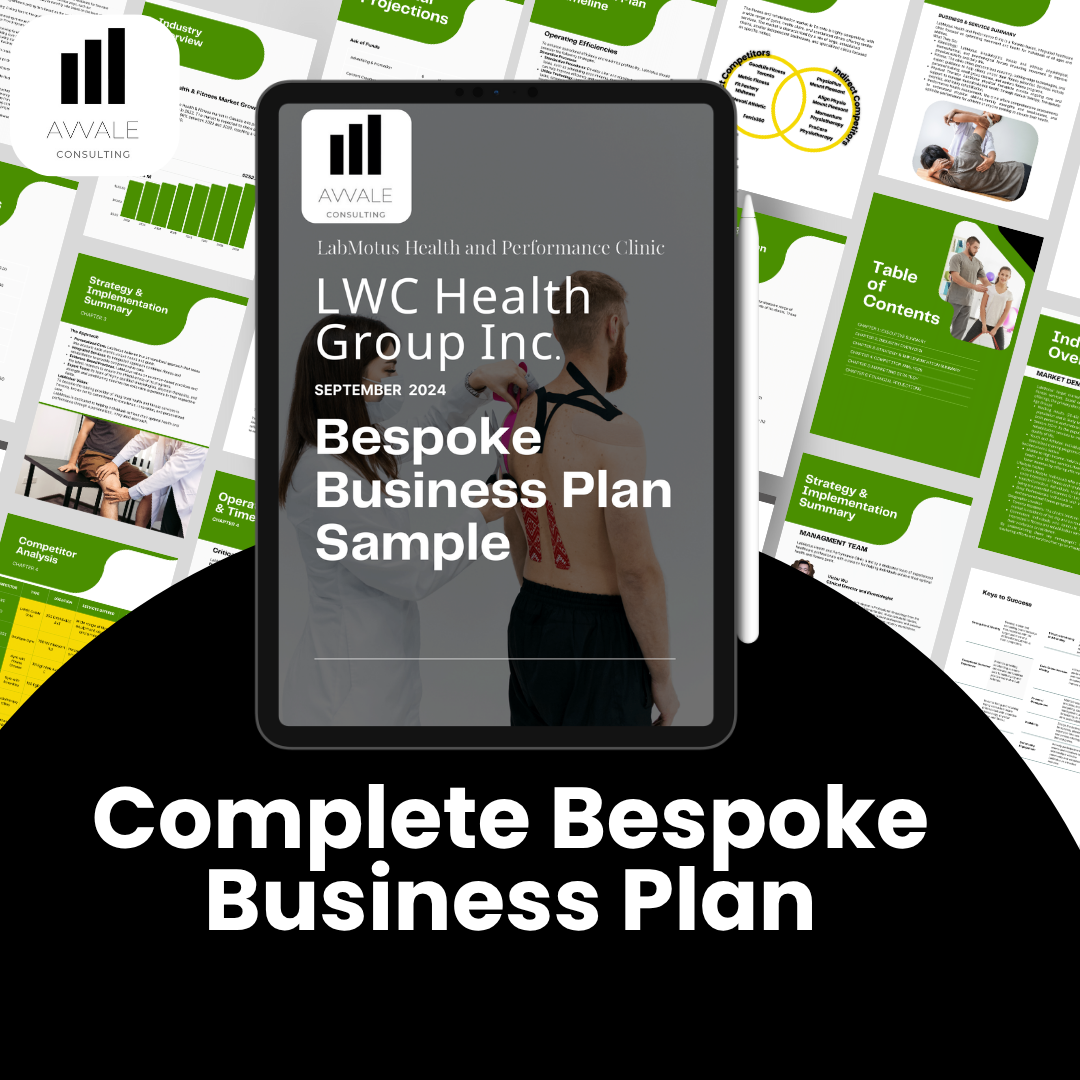
Bespoke Business Plan
Full plan + 5-year forecast. SBA, bank loan & investor ready.
Useful Links & Resources
These links were preserved from the live page so important references and partner links are not lost during the page refresh.